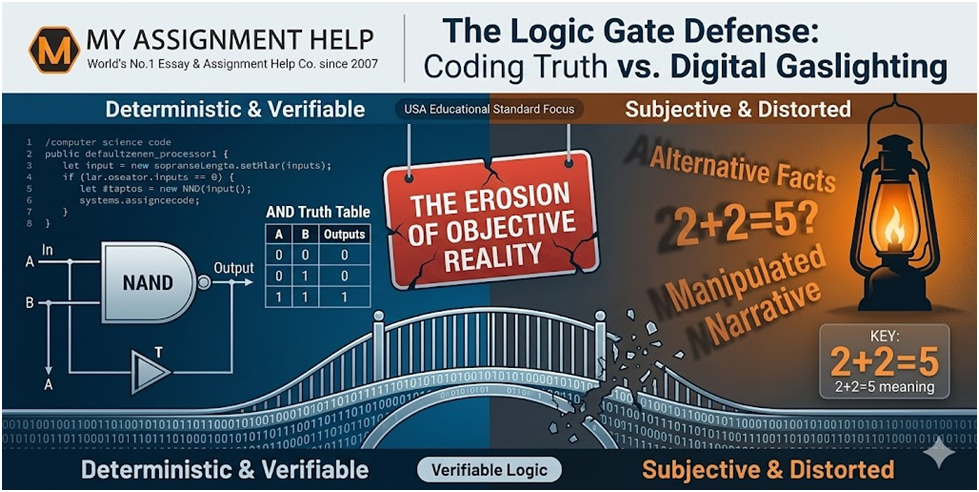
The Logic Gate Defense: How Binary Truth Fights Digital Gaslighting
In the modern digital landscape, truth is often viewed through two distinct lenses: the immutable, binary precision of silicon and the fluid, often manipulated narratives of human discourse. At the heart of every device we use lies the logic gate—a physical representation of Boolean algebra where “True” and “False” are not suggestions, but physical states. Yet, as we step away from the screen, we increasingly encounter a world where the objective is sacrificed for the narrative, a phenomenon best encapsulated by the chilling Orwellian trope: 2+2=5.
The Incorruptibility of the Logic Gate
To understand the current tension between technology and truth, one must first appreciate the rigid honesty of hardware. Every software application, from a simple calculator to complex neural networks, relies on logic gates. These components do not have the capacity for nuance; they operate on a fundamental requirement for accuracy.
In the United States, the tech sector’s dominance is built upon this uncompromising reliability. When developers write computer science code, they are essentially arranging these logical instructions to perform tasks that require absolute certainty. In this environment, an error is not an “alternative fact”—it is a bug.
The Technical Standard: The “AND” Gate Truth Table
To visualize this, consider the AND gate. It only produces a “True” (1) output if all inputs are “True.” This is the antithesis of gaslighting, where truth is often selective.
| Input A | Input B | Output (Result) |
| 0 (False) | 0 (False) | 0 (False) |
| 0 (False) | 1 (True) | 0 (False) |
| 1 (True) | 0 (False) | 0 (False) |
| 1 (True) | 1 (True) | 1 (True) |
Gaslighting the System: When Logic Meets Human Psychology
While machines are bound by the laws of physics, the human mind is susceptible to “gaslighting”—a form of psychological manipulation where a person is made to question their own reality. This creates a fascinating paradox in 2026: we live in a world built by logical machines but governed by increasingly illogical social narratives.
The phrase “2+2=5” originated as a symbol of dogma overstepping reality. Understanding the 2+2=5 meaning is essential for students of both humanities and technology, as it highlights the vulnerability of objective truth when faced with persistent, systematic misinformation.
The Convergence: Algorithm Bias and Digital Gaslighting
The “bridge” between these two worlds is where the danger lies. As we outsource our decision-making to algorithms, the “gaslighting” becomes automated. If the data fed into a system is skewed, the resulting “logical” output becomes a vehicle for falsehood.
- Echo Chambers: Algorithms designed to maximize engagement often prioritize sensationalism over fact.
- Deepfakes: Sophisticated programming is used to create a “2+2=5” scenario where our eyes deceive our logic.
- Data Provenance: Without a rigorous understanding of how information is processed, users cannot distinguish between a logical output and a manipulated narrative.
Data-Driven Insights: The Cost of Illogic
According to a 2025 report by the Cybersecurity & Infrastructure Security Agency (CISA), cognitive manipulation campaigns have seen a 40% increase in sophistication. Furthermore, a study from MIT revealed that false information spreads six times faster on social platforms than the truth. This underscores the necessity of returning to the “Logic Gate” mindset—one that demands verification.
Key Takeaways
- Binary Precision: Computer science relies on absolute truths; there is no room for “alternative” logic in functional programming.
- Psychological Vulnerability: Gaslighting seeks to break the human “logic gate,” forcing acceptance of contradictory info.
- The 2+2=5 Symbolism: This trope remains a powerful warning against the erosion of objective reality in US academic spheres.
- Digital Literacy: Combining technical coding knowledge with philosophical logic is the only way to navigate 2026.
FAQ Section
How does computer science help identify gaslighting?
Computer science emphasizes “Computational Thinking”—a process of breaking down problems and verifying facts through logical steps. This analytical mindset makes it easier to spot inconsistencies and logical fallacies in manipulative narratives or biased data sets.
Is the “2+2=5” concept relevant to tech professionals?
Yes. For engineers and data scientists, it represents the danger of algorithmic bias. It serves as a reminder that if the underlying logic or data is compromised, a system can be forced to produce “true” results that are factually false.
Why is the USA central to the “Post-Truth” debate?
As the global hub for software development and social media, the US is the primary battleground for the conflict between technological logic and digital misinformation. American educational standards increasingly focus on digital literacy to combat these cognitive threats.
References
- Orwell, G. (1949). 1984. Secker & Warburg.
- CISA (2025). Annual Report on Cognitive Security and Algorithmic Integrity.
- MIT Sloan (2024). The Mechanics of Misinformation: Why Falsehoods Outpace Facts.
Author Bio:
Dr. Aris Thorne is a Senior Content Strategist and Lead Academic Consultant at MyAssignmentHelp. With over 15 years of experience in Software Engineering and a PhD in Philosophy of Technology, Dr. Thorne specializes in bridging technical rigor with socio-ethical analysis for US students and professionals.