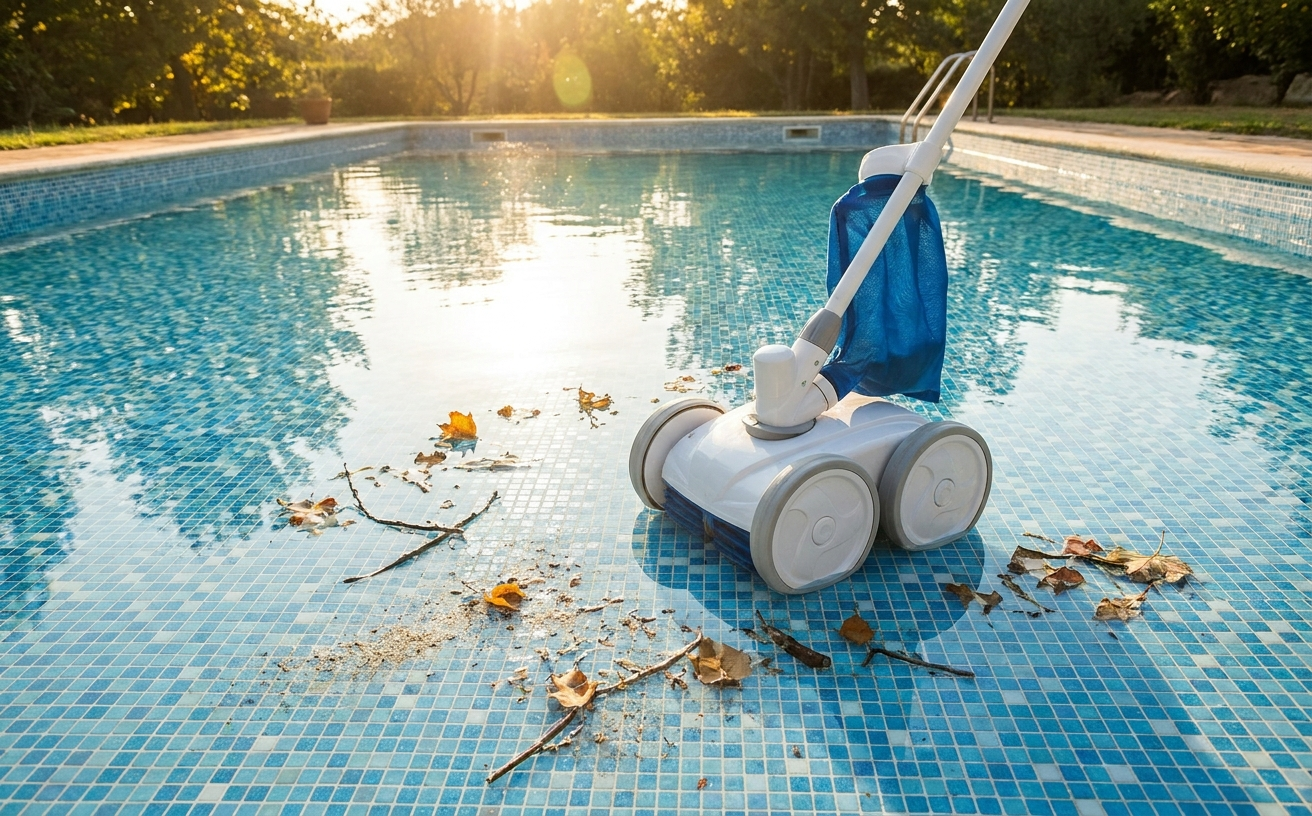
Your Pool Cleaner Stopped Moving — Now What?
One day it is crawling across the pool floor doing its job. The next day it sits in one spot, wheels motionless, while debris accumulates around it. Pool cleaner movement failures are common, and most of them are fixable without replacing the unit. The key is diagnosing which component has failed before you start replacing parts randomly.
The diagnosis depends on what type of cleaner you have. Pressure-side, suction-side, and robotic cleaners each have different failure modes, and the troubleshooting steps for one type do not apply to the others.
Pressure-Side Cleaners: Check the Water Supply
Pressure-side cleaners depend on a dedicated booster pump that forces water through a hose to drive the cleaner. If the booster pump is not running, the cleaner has no power source and cannot move. This is the first thing to check, and it is also the easiest to overlook.
Verify that the booster pump is receiving power and that the timer is set correctly. Check the pump basket for debris that might be restricting flow. Listen for unusual sounds that might indicate a failing motor or a clogged impeller.
If the booster pump is running but the cleaner is still not moving, disconnect the hose at the cleaner end and feel the water pressure coming through. Weak pressure indicates a blockage in the hose, a leak at a connection, or a failing booster pump that is running but not producing adequate flow.
Common Hose Problems
The hose is the most vulnerable part of a pressure-side cleaner system. It sits in the water and sun continuously, develops cracks and leaks, and catches on ladders, lights, and other pool fittings.
A leak in the hose reduces the water pressure reaching the cleaner. Even a small crack can bleed off enough pressure to stop the cleaner from moving while the booster pump continues to run normally. To find a leak, run the system and watch the hose for air bubbles or water spray while it is under pressure.
Hose length also matters. If the hose is too short, the cleaner cannot reach the far end of the pool. If it is too long, the excess hose coils and tangles, restricting flow and creating drag that slows or stops the cleaner. The hose should reach the farthest point in the pool with about two feet of slack.
Suction-Side Cleaners: Check the Suction
Suction-side cleaners are powered by the main pool pump through the skimmer or a dedicated suction line. If the cleaner is not moving, the first check is whether there is adequate suction at the connection point.
Remove the cleaner from the hose and place your hand over the hose end. You should feel strong, consistent suction. Weak suction indicates a clogged skimmer basket, a full pump strainer, a dirty filter, or an air leak in the suction line.
If suction is strong but the cleaner is still not moving, the internal mechanism may be jammed. Debris can wedge in the throat of the cleaner or tangle around the internal turbine. Disassemble the cleaner body according to the manufacturer instructions and remove any visible obstructions.
Robotic Cleaners: Power and Filter Issues
Robotic cleaners are self-contained and do not depend on the pool pump. When a robotic cleaner stops moving, the cause is usually internal. Start by checking the power supply. Verify that the transformer is plugged in, the indicator light is on, and the cable is properly connected to the cleaner.
If power is confirmed, the most common cause of a stopped robotic cleaner is a clogged filter. A completely blocked filter prevents water from flowing through the pump, which causes the pump to overheat and triggers a thermal shutdown. The cleaner appears dead but is actually in protective shutdown mode.
Clean the filter thoroughly, let the cleaner cool for thirty minutes, and try again. If it starts and runs normally, the problem was filter clogging. If it starts and stops again quickly, the pump motor may be failing and drawing excessive current.
Diagnosing Drive System Failures
When power and filtration are not the problem, the drive system is the next suspect. Drive failures manifest as the cleaner running but not moving, or moving in circles, or moving only one wheel.
For anyone troubleshooting a polaris pool vacuum not moving, the drive belt is the first mechanical component to inspect. The belt connects the water motor to the wheel assembly. If the belt is broken or has slipped off its pulley, the water motor spins but the wheels do not turn. Replacing the belt is inexpensive and straightforward on most models.
Worn gears in the wheel assembly produce a grinding or clicking sound and cause the cleaner to move erratically or not at all. Gear replacement requires disassembly and specific replacement parts, but it is less expensive than replacing the entire cleaner.
When Replacement Makes More Sense
Not every stopped cleaner is worth fixing. If the unit is more than five years old and has multiple failing components, the cumulative repair cost may approach the price of a new unit. A cleaner that needs a new pump motor, a new drive belt, and a new hose is not a good candidate for repair.
Robotic cleaners with failed pump motors are particularly costly to repair. The pump motor is the most expensive single component, and replacing it requires waterproof sealing that is difficult to achieve without factory equipment. In most cases, a failed pump motor on a robotic cleaner older than three years justifies replacement.
Pressure-side and suction-side cleaners are generally more repairable because their components are simpler and less integrated. A failed belt, a worn gear, or a cracked hose can be replaced individually without touching the rest of the system.
Preventing Movement Failures
Most movement failures develop gradually from conditions that could have been addressed early. A few preventive habits significantly reduce the frequency of stopped cleaners.
- Clean the filter or empty the debris bag after every use
- Inspect the hose for cracks and leaks monthly
- Store the cleaner and hose out of direct sunlight when not in use
- Keep the skimmer basket and pump strainer clear to maintain consistent suction
- Run the cleaner on a regular schedule rather than only when debris is heavy
A cleaner that runs regularly stays limber and functional. A cleaner that sits unused for weeks is more likely to develop stuck seals, brittle hoses, and corroded electrical connections. Consistent use is itself a form of maintenance.
When your cleaner stops moving, resist the urge to replace it immediately. Most failures are single-component issues that cost a fraction of a new unit to fix. Diagnose first, repair second, and replace only when the math no longer supports repair.